Care Needs Assessments as Instruments of Long-Term Care Eligibility and Expenditure
Aging-ResearchLong-Term-CarePublished on: Sep 30, 2026
Population Aging and Fiscal Pressure on Long-Term Care Systems
Population aging is increasing the demand for long-term care (LTC) across Europe, creating pressures on public budgets that already accommodate pensions, healthcare, and other commitments. To date, the literature has addressed the fiscal implications of LTC from a macro-perspective, treating them as functions of demographic change and system-level generosity. For example, fiscal sustainability of LTC systems has so far been evaluated through aggregate indicators such as expenditure as a share of GDP, coverage rates, and financing arrangements.
Although relevant for understanding LTC system financing, these approaches obscure the specific mechanism through which access to publicly financed care is operationalized at the individual level: the care needs assessment (CNA). The CNA defines who qualifies for care within a given system and is determined by a set of criteria established by legislators, as well as an individual’s care needs profile (dependency level). As a result, the CNA governs the size of the population entitled to support and, by extension, the volume of publicly financed care. In a recently published article, we examined the CNA as a determinant for LTC eligibility and financing, showing how its design generates divergent outcomes across different LTC systems.
Care Needs Assessments and the Basis for Cross-Country Comparison
A CNA is a formal procedure that quantifies dependency and determines LTC system eligibility using parameters such as:
- Which eligibility domains are assessed, including physical limitations, activities of daily living (ADLs), instrumental activities of daily living (IADLs), and cognition
- How limitations are measured (time-based calculations, point-based scoring, or professional judgment)
- What thresholds must be reached to qualify
These parameters define the operative boundary of public coverage, which then determines the size and composition of the eligible population.
CNA design varies substantially across countries along each of these dimensions, which makes systematic comparison difficult without a common analytical framework. Germany, for example, applies a weighted points-based assessment across six domains to assign one of five care levels; Austria uses a time-based system in which predefined care tasks are assigned monthly care-hour values that determine one of seven care levels; and Belgium applies a six-item ADL/IADL scale scored per item, with the total determining one of five dependence categories. These differences mean that the same individual with a given functional profile might have varying eligibility outcomes across different CNAs.
To explore this hypothesis, we used the Gateway LTC Policy Explorer, which documents and harmonizes LTC policies—including national CNA systems—across countries and provides resources to support needs-based eligibility estimation. For full details on how these institutional rules were gathered and standardized, refer to Knapp et al. (2026), which documents the construction and capabilities of the Gateway LTC Policy Explorer.
Harmonizing policy documentation makes it possible to apply CNA rules to comparable, cross-country survey data in order to identify eligibility differences across these systems. For this study, we combined the Gateway LTC Policy Explorer with harmonized health data from the Survey of Health, Ageing and Retirement in Europe (SHARE), focusing on individuals aged 65+ from eight European countries with objective CNAs. We evaluated how differences in CNA design influence individual eligibility by cumulatively introducing IADL and ADL limitations and identifying each country's eligibility threshold (see Figure 1).
The first thing we noticed is that no system grants eligibility based on a single IADL limitation alone. Beyond that, systems differ in the minimum number of limitations required to qualify: Luxembourg's Assurance Dépendance grants eligibility at a level of need met by partial assistance with eating, whereas other systems require a greater accumulation of limitations before eligibility is granted. As more limitations are added, eligibility extends across more systems, and by the point at which bathing difficulty is included, all eight systems grant eligibility. That said, Figure 1 only reflects one ordering of limitations, and a country's threshold depends on the specific combination of limitations, not just the count.
Figure 1. Progressive ADL Scenario Analysis
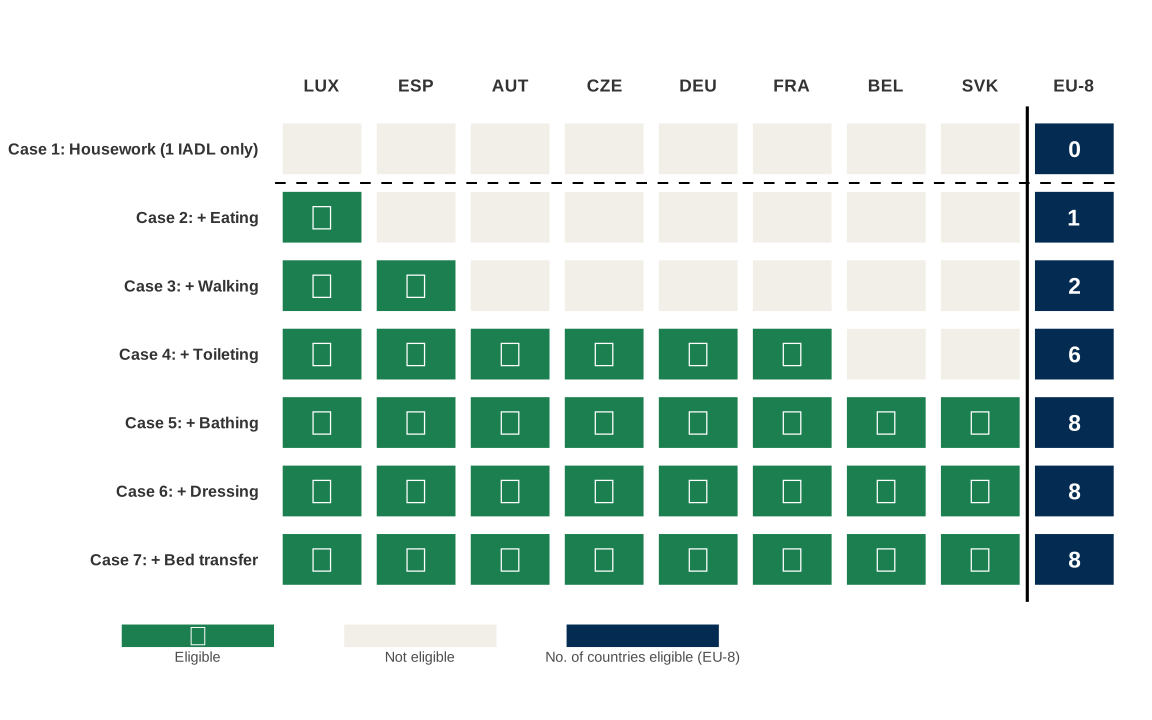
Notes: The figure summarizes hypothetical scenarios of IADL/ADL progression and country specific eligibility. The countries considered are Austria (AUT), Germany (DEU), Spain (ESP), France (FRA), Belgium (BEL), Czech Republic (CZK), Slovakia (SVK), and Luxembourg (LUX).
Source: Figure 1, Davila et al. (2026)
In our article, we show how ordering these limitations differently influences eligibility across systems, systematically varying combinations of ADL and IADL limitations to produce 1,066 synthetic profiles. Furthermore, we apply country-specific criteria to a common sample of the European population aged 65 and over to estimate how many of those people would be eligible under each system.
Policy Implications
The results indicate that eligibility for publicly financed LTC depends on each country's definition of need and the stringency of its criteria, both embedded in the CNA, and not on the level of functional limitation alone. Two individuals with identical functional profiles can receive different eligibility determinations simply because they are assessed in different countries. This implies that CNA design decisions, including which domains are assessed, how limitations are scored, and where thresholds are set, determine the composition of the population that receives benefits.
CNA design choices also carry fiscal consequences. Adjusting thresholds, removing domains, or recalibrating how limitations are classified can expand or contract the eligible population, and correspondingly public expenditure on LTC, without a formal change to the statutory framework. Seen this way, CNA design functions as a determinant of expenditure as well as access, and its design and revision can be incorporated into LTC policy and budgeting decisions and evaluated for their consequences for access and public spending. Whether these cross-country eligibility differences translate into differences in LTC service use is a question for future research.
About the authors:
- Dr. David Knapp is an Economist at the University of Southern California.
- Heber Dávila is a PhD student at Ca' Foscari University of Venice and a visiting scholar at the University of Southern California.
- Yeeun Lee is a research program specialist at the University of Southern California.