Expanding the LTC Policy Explorer: New Resources for Examining Care Needs Assessments and Eligibility Criteria
Aging-ResearchData-HarmonizationLong-Term-CarePublished on: Mar 12, 2026
The Gateway Policy Team is pleased to announce the launch of two new resources within the Long-Term Care (LTC) Policy Explorer: LTC Assessment Components and LTC Need Assessment Mappings. These additions expand the Policy Explorer's existing suite of resources, complementing the International and Unites States LTC Policy sections to provide users with deeper insight into care needs assessment frameworks and eligibility criteria across countries worldwide and US states.
This blog post explains what LTC Assessment Components and LTC Need Assessment Mappings are, how to use them, and covers planned updates to these resources.
Introduction
The Gateway to Global Aging Data is a data and information platform designed to support cross-national and longitudinal research on aging through the Health and Retirement Study (HRS) and its international network of studies (HRS-INS). Within this platform, the Gateway Policy Explorer's LTC section offers a comprehensive overview of LTC policies across countries and US states spanning more than two decades.
As LTC policies change over time, identifying the regulatory framework in place at the time of a survey has become an increasingly complex task for researchers. To address this challenge, the Gateway has compiled comprehensive, harmonized historical policy information at both the country and US state level. Central to how LTC systems function in practice is the use of care needs assessments, which govern access to benefits and determine the eligibility and amount of services provided. Linking detailed policy information with longitudinal, person-level data allows researchers to investigate how variation in care need definitions and eligibility thresholds shapes access to care. These resources were developed to make information on how LTC systems function more accessible and actionable for the research community.
Building the Resources: Our Harmonization Process
To develop these resources, the Gateway LTC team designed a five-step harmonization process (depicted in Figure 1) to systematically link LTC policy information with HRS-INS survey data in a consistent and comparable way across countries worldwide and US states:
- Policy collection and documentation (International, US State): Historical LTC policies were collected and systematically documented using standardized language for LTC eligibility criteria and benefit structures.
- Care needs framework: A common framework of care needs was developed by compiling all tasks and items included in country- and state-specific care needs assessments (CNAs) and organizing them into broader activities (e.g., walking) and more detailed sub-activities (e.g., moving inside the house). Currently there are 251 distinct sub-activities identified from country and state care need assessments, listed in the detailed tab of the framework.
- LTC Assessment Components: For each sub-activity, plausible survey questions from the HRS-INS harmonized datasets were identified to inform the corresponding care needs category, ensuring consistent implementation. A standardized scale of impairment is defined for the sub-activity, typically ranging from fully dependent to independent. At present, 165 sub-activities are linked to HRS-INS survey questions. For example, the sub-activity of overall bathing is linked to the following survey questions: difficulty with bathing and needs help with bathing. The remaining 86 sub-activities are identified in at least one LTC assessment, but have no questions in the HRS-INS surveys that can inform whether respondents exhibit a deficit in the sub-activity.
- LTC Need Assessment Mappings: The identified LTC Assessment Components were mapped onto country- and state-specific LTC assessment tools, independently of the specific survey questions. Currently, 72 assessments are mapped, with additional mappings being added in the future as they are completed.
- Eligibility prediction (coming soon): Using the LTC Need Assessment Mappings, assessment criteria were coded and applied to HRS-INS data to predict needs-based eligibility for care. These measures will be added to Gateway Harmonized datasets when they become available.
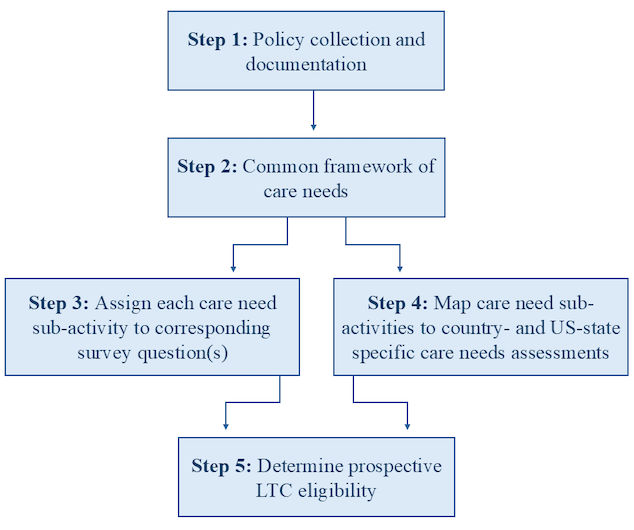
Figure 1. Summary of the Data Harmonization Process.
While all five steps are integral to this process, the following sections focus on steps three and four, the LTC Assessment Components and LTC Need Assessment Mappings, which form the foundation for predicting LTC needs-based eligibility using HRS-INS data.
Long-Term Care Assessment Components
LTC Assessment Components are designed to ensure the consistent application of HRS-INS survey questions across country- and state-specific care needs assessments. For each sub-activity, the assessment component documentation includes:
- Assessment Component Definition (Introduction): An interpretation of the sub-activity.
- Related HRS-INS Survey Measures: Plausible HRS-INS survey questions were identified that could inform the corresponding sub-activity.
- Assigned Scales: A standardized scale of impairment is defined for the sub-activity, typically ranging from fully dependent to independent.
- Application of Survey Measures to Assigned Scale: A brief discussion and summary table outlining how survey responses are interpreted.
To illustrate, the following example presents the assessment component for overall walking — a sub-activity within the broader activity of transferring and walking — which captures the generic ability to walk inside or outside the house. We identified several HRS-INS questions which could inform this sub-activity:
- Q1. Difficulty walking across the room
- Q2. Needs help getting in and out of bed and walking across a room
- Q3. Difficulty with walking a short distance (e.g., 100m, 100 yards, one block)
Survey variables are used to classify individuals into one of four levels of impairment: independent, semi-independent, semi-dependent, and dependent. Figure 2 illustrates this classification for overall walking.
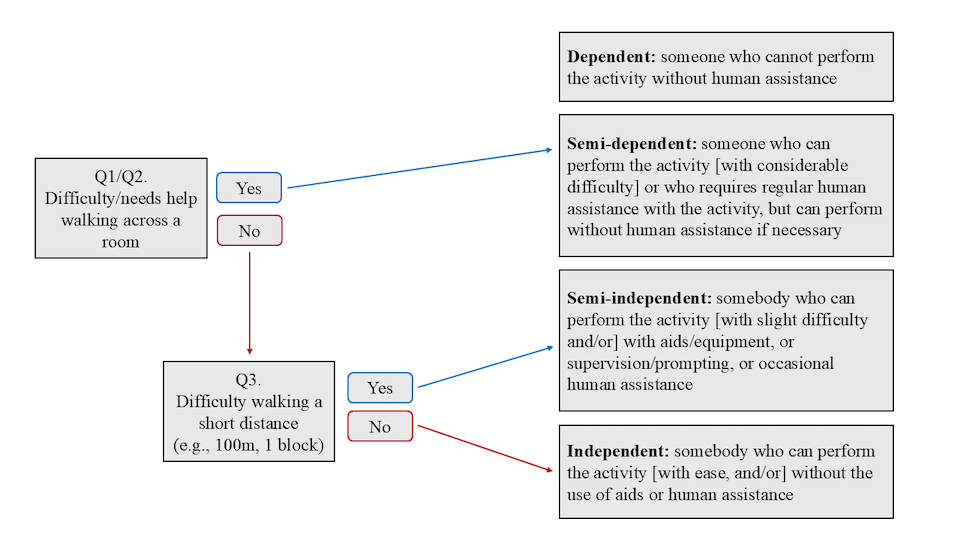
Figure 2. Assessment Component for Overall Walking.
The assessment component also provides guidance on how to apply survey responses to the impairment scale across three alternative scenarios (conservative, baseline, and expansive). To accommodate varying interpretations of the HRS-INS survey questions, three alternative scenarios are provided — from conservative to expansive — enabling researchers to choose the one that best aligns with their research objectives. The conservative scenario interprets survey questions as less suggestive of impairment than the baseline and may use additional information to reduce or match impairment levels. The baseline scenario reflects the standard interpretation. The expansive scenario interprets survey questions as more suggestive of impairment than the baseline and may use additional information to increase impairment levels. Importantly, ability is assessed independently of any reports of receiving help with associated activities. Figure 3 illustrates how responses to the identified survey questions are applied to the impairment scale under each scenario for overall walking.
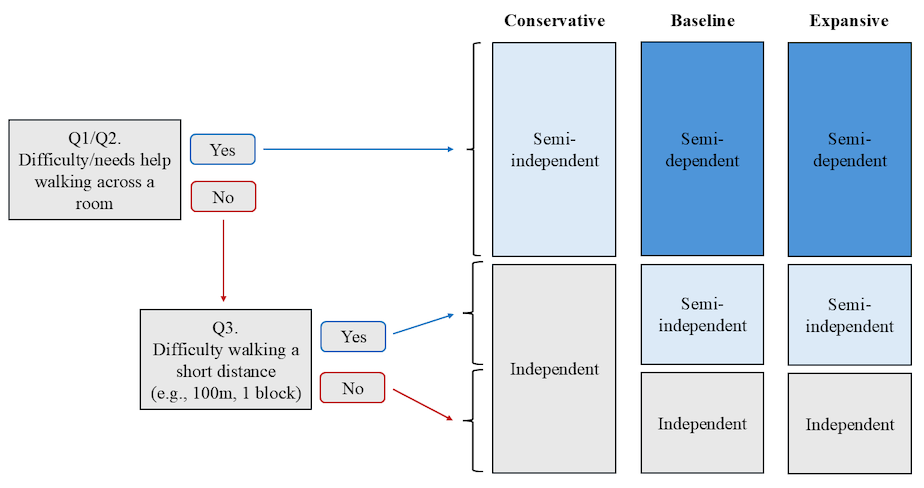
Figure 3. Application of Survey Measures to the Impairment Scale for Overall Walking.
Reliable HRS-INS survey measures could not be identified for some assessment components, such as tracheostomy care. These components are still included, as they were recognized in care needs assessments across countries and US states, and an interpretation is provided.
LTC Assessment Components are available for all sub-activities within the care needs framework and can be accessed through the LTC Assessment Components tab of the LTC Policy Explorer. To explore a specific assessment component, select an Activity from the first dropdown menu, then select a Sub-activity to view the corresponding documentation. Researchers focusing on a particular care need, such as mobility or personal hygiene, may find it useful to browse the available activities and sub-activities to identify the components most relevant to their work.
Long-Term Care Need Assessment Mappings
LTC Need Assessment Mappings document how assessment components are applied to each country- or state-specific LTC assessment. A new mapping is created for each program and time period, provided the program has clearly defined eligibility criteria. For programs where eligibility is determined by the professional judgment of an evaluator rather than explicit, predefined criteria, or where eligibility criteria could not be identified, no mapping was created. For example, if a country or state has three different LTC benefit programs, and one of those programs changes its eligibility criteria once between 1992 and 2026, four mappings would be created: one for each program, and an additional mapping to reflect the change in criteria. Each LTC Need Assessment Mapping consists of two parts:
- System Review: Provides contextual information about the country or state's LTC system, including the types of benefits and programs available, how care needs are defined, the assessment items used, and the eligibility thresholds and scoring criteria.
- Component Mapping: Documents how each assessment item in a care needs assessment is linked to a corresponding assessment component. Where an assessment component is available and informative, the equivalent impairment level from the assessment component scale is identified and mapped onto the country- or state-specific scale.
An LTC Need Assessment Mapping takes different forms depending on the structure of the assessment:
- Scoring-based systems: Each impairment level is assigned a corresponding point value or range. For an example, see Figure 4 below.
- Assessments that use definitions and single thresholds: The equivalent cutoff on the impairment scale is identified. For an example, refer to the Georgia mapping.
Text shown in gray on the website indicates impairment levels or assessment items that cannot be assigned from available HRS-INS survey questions, while black text indicates those that can be assigned. Examples of where gray text appears include: impairment levels in the mapping that fall outside the range determinable from survey data (e.g., managing toilet needs or incontinence at 6 and 8 points in the England mapping), assessment components that are available but deemed insufficiently informative or lacking corresponding survey questions (e.g., catheter care in the Georgia mapping), and assessment items for which no corresponding assessment component exists (e.g., monitoring of vital signs in the Georgia mapping.
Figure 4 presents an example of the mapping for England's Cash Benefit care needs assessment, which uses a point-based scoring system. For the sub-activity of overall preparing food, each assessment criterion is assigned a point value that is then mapped onto the corresponding impairment level as defined in the assessment component. For example, an individual unable to prepare and cook food without assistance (8 points in England) is classified as dependent on the assessment component scale, whereas someone who can prepare and cook a simple meal unaided (0 points in England) is classified as independent on the assessment component scale.
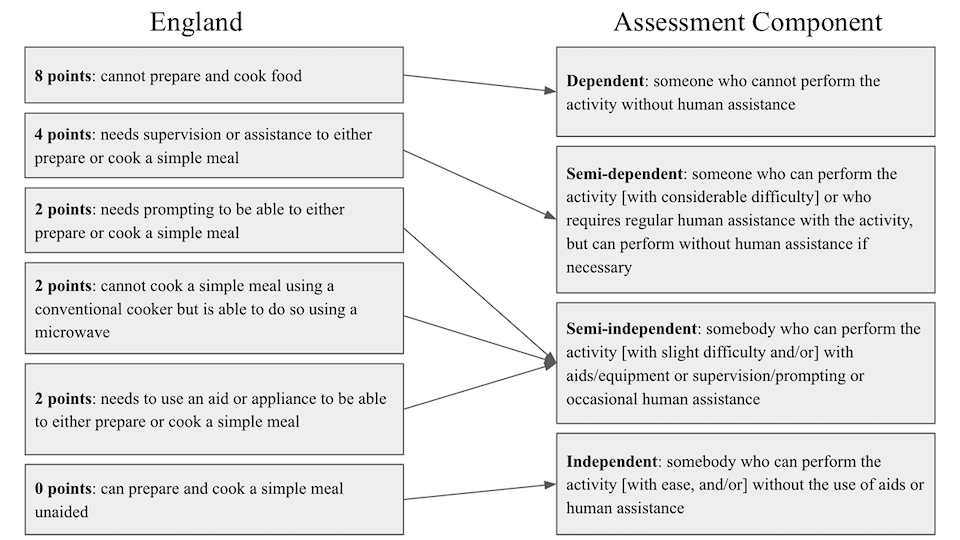
Figure 4. Example Mapping for England Cash Benefit: Overall Preparing Food.
LTC Need Assessment Mappings are available for all countries and US states for which the Gateway has published LTC policy documentation and where clearly defined eligibility criteria could be identified, and can be accessed through the LTC Need Assessment Mappings tab of the LTC Policy Explorer. To explore a specific mapping, select a Country/State from the first dropdown menu, then select a Program to view the corresponding system review and mapping. Researchers studying a specific country's or US state's LTC system may find it useful to start by selecting that location in the mappings tab before cross-referencing the relevant assessment components. Within the mapping, sub-activity names appear as clickable links that navigate directly to the corresponding assessment component, allowing users to move seamlessly between the two resources.
Next Steps
The LTC Assessment Components and Mappings support research on how care needs are measured and defined across LTC systems. An early application of this framework in Avendano et al. (2026) demonstrates that eligibility for LTC benefits based on the country’s care needs assessment can lead to substantial variation in eligibility even conditional on functional limitations in activities of daily living.
The Gateway LTC Team will continue to expand the LTC Need Assessment Mappings as new LTC policy documentation is published for additional countries and US states. The fifth and final step of the harmonization process, eligibility prediction, will be released in the near future in the form of LTC eligibility variables included as part of the core Gateway Harmonized datasets, along with accompanying documentation. For US states, these forthcoming eligibility variables will also include eligibility measures based on financial means. Updates to these resources will be announced as they become available.
Additional Detail on the Implementation of the Gateway LTC Harmonization Process
The LTC policy documentation and harmonization process featured here and summarized in Figure 1 was completed by the Gateway LTC Policy team, an international collaborative team of researchers. Historical policy collection and documentation (Step 1) has been ongoing since 2022, with the first release of the Gateway’s LTC Policy Explorer occurring in September 2023. In January 2024, the Gateway LTC Policy team met to begin the rest of the Gateway LTC Harmonization process (Figure 1). At that meeting, an initial draft of the common framework of care needs (Step 2) was compiled based on the 31 country and state assessments collected by that time. Common activities and sub-activities were consolidated, and synonymous terminology was identified. The creation of the LTC assessment components (Step 3), which involved linking activities to survey questions was handled by one or two members on the team from January-June 2024, and presented to subject matter experts in cases where the study team did not have expertise (e.g., behavioral or cognitive components), and then revised and presented to the team for final decision. Mapping items assessed in the care need assessments (Step 4) to the sub-activities was drafted by one team member and presented to the team for final decision. Drafting assessment specific code to predict LTC benefit eligibility for the relevant HRS-INS survey (Step 5) was done by programmers and each assessment was presented to the team for review and discussion. Steps 4 and 5 were conducted through regular team meetings from April 2024 to February 2026. A final review was conducted in January-February 2026 to ensure consistency of the dependency classification for each sub-activity across the mapped assessments in Step 4.
This process is publicly available at g2aging.org/policy-explorer/long-term-care-policies, where each page is version-controlled and updated as new information becomes available.
The Gateway LTC Policy team continues to meet and update these resources. As new information becomes available (e.g., laws change, understanding or interpretation of policy changes), the website will be updated and the current version and date noted.
LTC Policy Team
- David Knapp, PhD, University of Southern California
- Drystan Phillips, MA, University of Southern California
- Yeeun Lee, MS, University of Southern California
- Maya Fransz-Myers, MSL, University of Southern California
- Eden Wetzel, MPH, University of Southern California
- Sterling Couts, MS, University of Southern California
About the authors:
- Dr. David Knapp is an Economist at the University of Southern California.
- Yeeun Lee is a research program specialist at the University of Southern California.