Advancing Aging & Exposome Research at GSA 2025
Aging-ResearchConferenceExposomePublished on: Dec 02, 2025
From November 12-14, the Gateway to Global Aging Data team attended the Gerontological Society of America (GSA) 2025 Annual Scientific Meeting in Boston, MA, where we met and shared materials with hundreds of attendees who stopped by our booth. We had great conversations with both new and experienced Gateway users, discussing how researchers are using and could use Gateway public datasets and the Gateway Enclave. Several colleagues also took a moment to stop by and say “thank you” for the resources and support we’ve provided; those moments reminded us that our work is making a tangible difference in the field.
Gateway Exposome Workshop
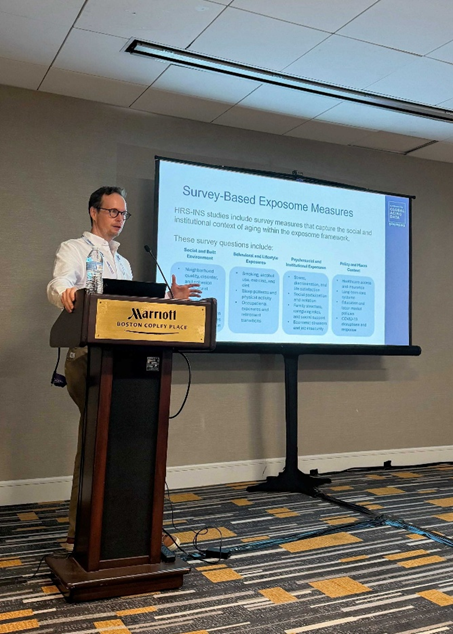
On Tuesday, November 12th, the Gateway to Global Aging Data and the Gateway Exposome Coordinating Center (GECC) co-hosted an Exposome Data Workshop at the Marriott Copley Place. The workshop brought together researchers studying the exposome (the sum of all exposures and experiences over an individual’s life) and its effects on late-life health and well-being.
Drystan Phillips (University of Southern California)opened the workshop, providing an overview of the Gateway platform, the different types of survey-based and linked exposome data available, and how researchers can engage with both public and restricted Enclave datasets. Next, Sara Adar (University of Michigan) delivered a presentation introducing the Gateway’s harmonized environmental exposures data, what the “exposome” means in the context of aging and cognition, and the importance of linking diverse exposures with longitudinal aging data. Kayleigh Keller (University of Colorado) then gave a methodological talk focused on statistical methods for exposome research. She explained how to handle high-dimensional exposures, repeated measures, and the linking of exposure metrics with cognitive outcomes. Finally, Emma Nichols (University of Southern California) provided an update on the GECC’s forward‐looking work. She highlighted the upcoming milestones and targets for the GECC and how researchers can get involved in shaping the research agenda.
The heart of the workshop comprised 18 presentations by early- and mid-career researchers who proposed exposome-focused analysis projects. The presentations were wide-ranging and included studies exploring how environmental exposures(e.g., fine particulate air pollution) affect cognition in older adults using linked datasets, such as the English Longitudinal Study of Ageing (ELSA) and the Longitudinal Aging Study in India–Diagnostic Assessment of Dementia (LASI-DAD). A subset of these projects also examined how neighborhood context and socioeconomic status influence late-life cognitive function and the risk of dementia, using the Gateway’s harmonized variables and Enclave‐based data on detailed exposures.
After each presentation, time was allotted for questions and responses. Presenters fielded questions from Gateway staff, senior researchers, and each other, strengthening their ongoing research and helping participants learn from one another. Notably, many of the preliminary findings presented at the workshop underscored how leveraging both publicly available harmonized data and Enclave‐linked, high‐resolution environmental exposures can accelerate the understanding of aging and cognition.
One of the main aims of the workshop is to connect participants with both senior researchers and other early-career researchers to help them build and grow their research networks. The networking lunch provided a dedicated opportunity for those conversations. Participants gathered in small mixed-career groups, discussed their research interests, and exchanged ideas about methods, datasets, and emerging questions in the field. The lunch helped strengthen the sense of community within the workshop and supported one of our core goals: fostering lasting research networks that will continue to grow beyond the event.
We would like to extend a heartfelt thank you to all the participants who engaged with us at the booth in Boston, attended the workshop, submitted research proposals, and offered feedback. We look forward to advancing exposome research together through both the Gateway’s and GECC’s forthcoming efforts. To stay up to date about events and new resources from the Gateway and GECC, be sure to sign up for the Gateway and GECC mailing lists.
About the author:
- Mario Chen